From empty land to a playable court in Bali: what you need to prepare, which court model fits, and how the build runs from foundation to handover.
16+ courts built in 8 cities across 4 provinces, from Surabaya to Merauke. See projects
Paramo was founded by padel players and is a padel court specialist working across Indonesia, including Bali. We handle planning, technical design, construction, and handover for villas, resorts, clubs, and commercial venues. Four courts are currently under construction in Uluwatu.
This page explains what a padel court in Bali involves, so you can judge a plan before any money is spent.
Courts are produced by partner factories in China, selected and supervised by Paramo.
| Project | Location | Courts | Status |
|---|---|---|---|
| Padel courts in Uluwatu | Uluwatu, Bali | 4 | Under construction |
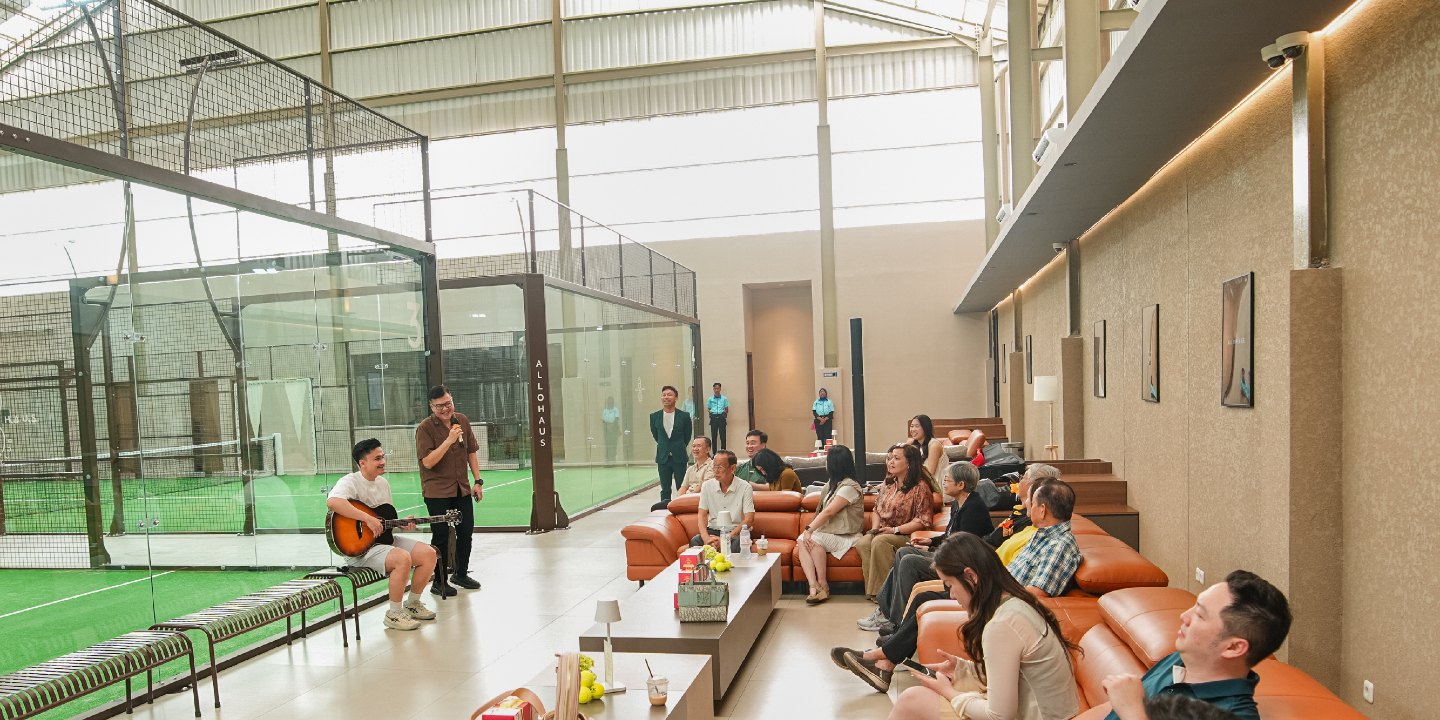
| Allohaus Social Club | Surabaya, East Java | 4, indoor, air-conditioned | Operating |
| The Vamos Padel | Jember, East Java | 2, indoor | Operating |
| Apex Padel Manado | Manado, North Sulawesi | Indoor | Operating |
| Indoor court in Tomohon | Tomohon, North Sulawesi | Indoor | Operating |
Photos of the finished projects are on our projects page.
All three models use the same glass, steel, and quality standard. What differs is the corner treatment and the line of sight.
| Model | Code | What sets it apart |
|---|---|---|
| Paramo PANORAMIC | 01A | Reinforced 100 × 100 mm corner columns for a more rigid frame |
| Paramo SUPER PANORAMIC | 01B | No corner columns, for an uninterrupted view |
| Paramo WPT | 02A / 03A | Curved corners with integrated rain protection |
Components in every model:
The full specification sheet is in our catalogue, and you can combine model, turf, and lighting in the court configurator.
The playing area is fixed at 20 m × 10 m. That is an international standard and cannot be reduced.
You need more land than the court itself, for an access path around the court, the column foundations, and an entrance. As a first planning figure, allow about 22 m × 12 m for one court.
For an indoor court, height is more often the problem than area. You need at least 6 m of clear height from the court surface to the lowest object above it, not to the roof peak.
The same court, with the same model, glass, and frame, can be installed in three settings:
Peak hours at most padel venues in Indonesia are late afternoon to evening and weekends, which is also when rain falls most often in the wet season. Wet artificial turf is slippery, so rain stops play. If your plan depends on evening bookings, a roof is a requirement rather than a luxury.
For an outdoor court, orientation matters. The long axis of the court should run north to south, so the rising and setting sun is on the long sides rather than behind a player. This costs nothing if decided at the start and cannot be fixed after the foundation is poured.
We do not quote a single build time on this page, because an honest figure depends on your location and site conditions. For projects outside Java, shipping is usually the longest stage, not installation.
With these, we can tell you whether the plan is feasible before any money is spent, including when the answer is not yet.
Yes. Paramo works across Indonesia, and four courts are currently under construction in Uluwatu, Bali.
The playing area is 20 m × 10 m. Allow about 22 m × 12 m of land for one court, to leave room for an access path, the column foundations, and an entrance.
Yes. The same court can be installed outdoors, under a roof with open sides, or fully indoors. Because rain stops play on wet turf, a roof is worth considering if your plan depends on evening bookings.
All three models use the same glass and steel. PANORAMIC has reinforced corner columns, SUPER PANORAMIC has no corner columns for an open view, and WPT has curved corners with integrated rain protection. Send us your location and number of courts and we will recommend a model.
Courts are produced by partner factories in China, selected and supervised by Paramo. Paramo is responsible for the specification and supervises installation on site.
“The finished court is neat, modern, and structurally solid.”
Ask the Paramo team directly on WhatsApp. Free consultation.